


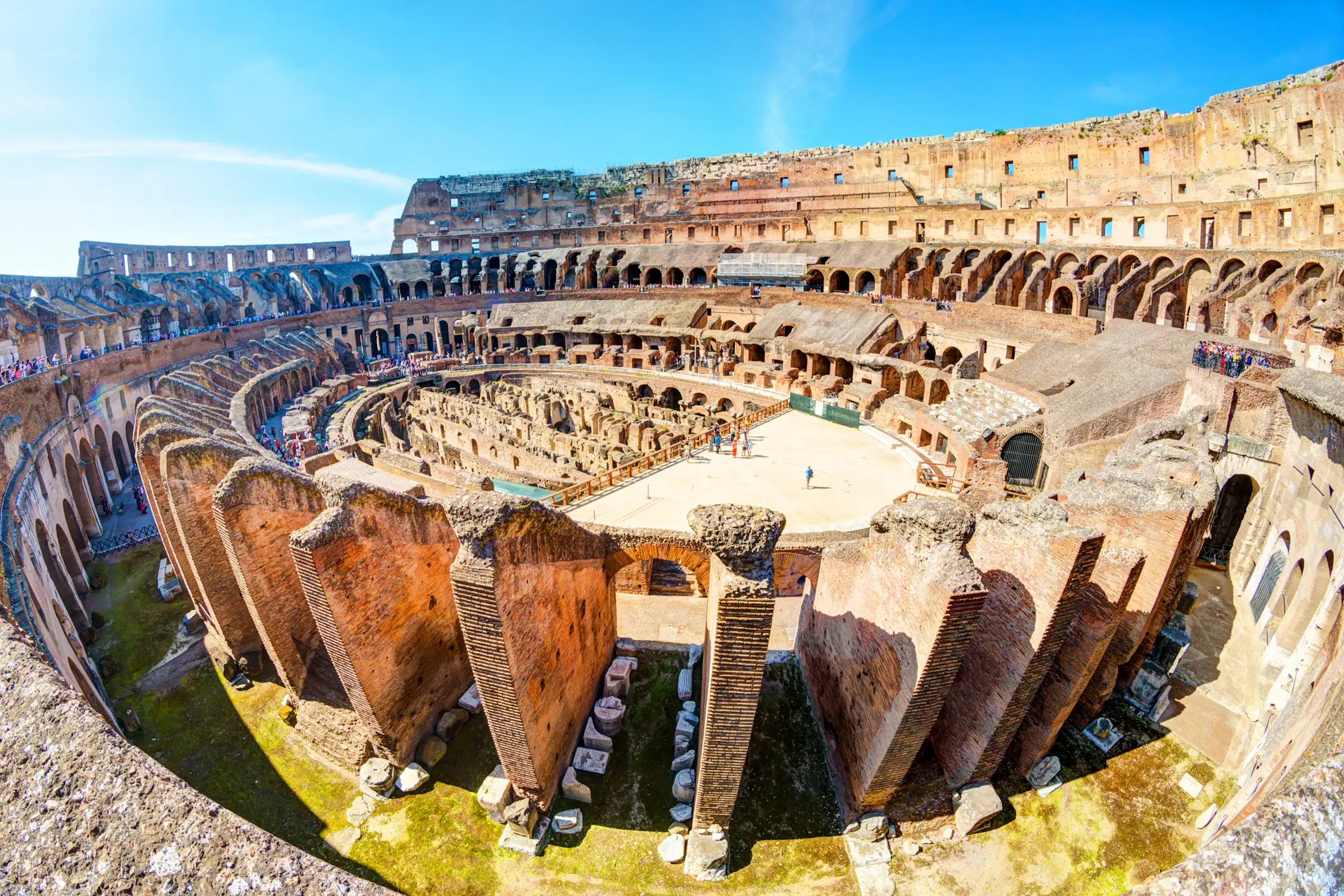

Colosseum, Roman Forum & Mamertine Prison: Reserved Entrance Ticket
Explore the ancient prison of St. Peter, the Colosseum and Roman Forum.
- Colosseum: Reserved Entry Ticket
- Roman Forum and Palatine Hill: Reserved Entry Ticket
- Mamertine Prison: Entry Ticket
- Downloadable multilingual audio guide
- Walking tour of Rome historical centre (if selected)


Colosseum - Tickets and Visitor Information
What is the Colosseum in Rome?
- The Colosseum is Rome's most famous landmark and one of the best-preserved monuments from the Roman Empire.
- Built almost 2,000 years ago, it once hosted gladiator contests, animal hunts and public spectacles for crowds of up to 50,000 people.
- It is Italy's most visited attraction and forms part of the Colosseum Archaeological Park alongside the Roman Forum and Palatine Hill.
- Most tickets include access to all three sites, making it one of the best-value historical attractions in Rome.
- Every year, millions of visitors come to the Colosseum to explore Ancient Rome, making it one of Europe's most popular attractions. Booking tickets in advance is strongly recommended, particularly during spring and summer when entry times often sell out.
Helpful Information
- Address: Colosseum, Piazza del Colosseo, 1, Rome, 00184
- Opening Hours: 08:30 - 19:15
- Suggested Visit Duration: 3-4 hours (including the Roman Forum and Palatine Hill)
- Nearest Metro: Colosseo (Metro Line B)
- Ticket Options
Is the Colosseum Worth Visiting?
- The Colosseum is one of the most famous landmarks in the world and a must-visit for anyone travelling to Rome.
- If you're interested in history, architecture or archaeology, the Colosseum is well worth visiting.
- Guided tours or Arena Floor and Underground access offers a deeper understanding of how the monument was built and used.
What You Can See At The Colosseum
- The Colosseum, its architecture and different levels, depending on ticket option.
- Options include the Emperor's Box & Gladiator's Gate.
- Different areas such as the arena floor and underground.
What is The Best Colosseum Ticket?
- This depends on what you would like at the Colosseum. For example if you want to include arena floor and the underground access and if you would like a guided tour or happy to explore by yourself. If you would like to access the arena floor and the underground, you should opt for a guided tour. However, if you are happy with just the main colosseim areas, the basic ticket would work for you.
{{ticket-block-triple}}
Colosseum Ticket Options
- Rome Tourist Card: Colosseum Entry+ Vatican Museums and Sistine Chapel Entry Ticket OR Castel Sant'Angelo Entry Ticket + either St. Peter's Basilica OR Rome Pantheon.
- Colosseum Budget Ticket: Colosseum + Roman Forum & Palatine Hill options.
- Colosseum Arena Floor Access Ticket: Colosseum (including Arena Floor access), Palatine Hill & Roman Forum.
- Colosseum & Mamertine Prison Ticket: Colosseum, Roman Forum and Palatine Hill entry ticket and Mamertine Prison entry (not Arena Floor access).
- Colosseum Guided Tour Tickets: Different options for different group sizes and access to different areas.
- Colosseum + Guided Tour + Access Ticket: Colosseum, Arena Floor, Underground with a Guided Tour and access to the Roman Forum & Palatine Hill.
About The Colosseum
The Colosseum in the heart of Rome. One of Italy's most famous landmarks and one of Rome's most popular attractions.
Constructed between 72-80 C.E. by Roman Emperors Vespasian and Titus, it was used as an amphitheatre for gladiatorial combats, animal hunts, mock naval battles, and even public executions.
The Romans called it the Flavian Amphitheatre, the Colosseum was actively used for around 500 years until the 6th century and it's now one of the ‘Seven Wonders of the Modern World’ and a UNESCO World Heritage Site under the 'Historic Centre of Rome' category.
It was constructed using concrete, sand, and travertine limestone in an elliptical shape with its famous façade making it instantly recognisable. It could accommodate up to 50,000 spectators. The exterior features three different types of columns, ‘Doric’, ‘Ionic’, and ‘Corinthian’, which highlight the beauty of classical Roman architecture.
Beneath the arena lies a network of ramps, tunnels, and elevators. The mechanical processes used to operate the trapdoors on the arena floor allowed dramatic entrances for gladiators and animals.
Much like modern arenas, spectators were seated according to their social status and wealth.
It has been damaged multiple times over the centuries including a major earthquake in the 1300s, water damage due to poor ground quality, and looting of stones.
Renovation projects have taken place over the years in order to preserve it. In 2017, the 4th and 5th tiers were reopened and they now offer views that hadn't been accessible for many years.
The Arena Floor
The arena floor was made of wooden planks and most probably covered with sand to provide traction and absorb blood during events. The word ‘arena’ is actually derived from the Latin word ‘harena’, which referred to a sandy place and over time, it became the word ‘arena’.
In recent years, significant efforts have been made to preserve and partially restore the floor and in 2021, plans were announced to rebuild parts of it using modern technology, allowing you to walk on it and better understand how it functioned.
The Hypogeum (Underground System)
The hypogeum was a later addition and was constructed under Emperor Domitian.
It consisted of two levels of underground tunnels and chambers. It featured a complex system of corridors, holding cells, and cages for animals and gladiators.
There were pulleys, winches, and counterweight systems which enabled the gladiators, animals and scenery to be hoisted to the arena floor, allowing for spectacular and unexpected appearances during events.
The hypogeum would have been divided into sections for different purposes, such as animal pens, preparation areas for performers, and storage for props and machinery.
Popular Tickets

Popular Attractions
Colosseum FAQs
- Do you need to book tickets for the Colossum in advance?
- Its not compulsory, but booking them in advance will help you secure your preferred time and date. Its one of the most popular attractions in Rome and during the summer months, tickets regularly sell out, so booking online inadvance can help you.
- When was the Colosseum built?
- Construction on the Colosseum began in 70 AD under Emperor Vespasian and was completed in 80 AD under his son, Emperor Titus.
- How many people could the Colosseum hold?
- It could accommodate between 50,000 and 80,000 spectators.
- What types of events were held at the Colosseum?
- Events held at the Colosseum included gladiator fights, animal hunts, mock naval battles, executions, and dramatic reenactments of famous battles.
- How was the Colosseum damaged?
- Over centuries, the Colosseum was damaged by earthquakes, stone robbing, and neglect.
- Is the Colosseum still in use?
- No, it is now one of the most popular tourist attractions in Rome and a historical site.
- Why is part of the Colosseum missing?
- Many of its stones were removed during the Middle Ages and Renaissance for building other structures, like St. Peter's Basilica.
- Is the Colosseum a UNESCO World Heritage Site?
- Yes, the Colosseum is part of the Historic Centre of Rome, a UNESCO World Heritage Site since 1980.
- How long did it take to build the Colosseum?
- It took around 10 years to build the Colosseum, from 70 AD to 80 AD.
- What time of year is best to visit the Colosseum?
- Spring and Autumn are ideal due to milder weather and smaller crowds. Early morning or late afternoon visits are best to avoid peak crowds.
Colosseum Fun Facts
- It had a retractable roof: The Colosseum featured a velarium which was a massive awning system that could be deployed to shade spectators from the sun.
- Gladiator fights at the Colosseum weren’t always deadly: Contrary to popular belief, many gladiator battles ended without death, as gladiators were valuable assets.
- It was built on a former lake: Emperor Nero’s artificial lake was drained to make space for the Colosseum, symbolising the return of land to the Roman people.
- It’s the largest amphitheatre ever built: No other amphitheatre in the world surpasses the Colosseum in size!
- It was covered in marble: Originally, the exterior was clad in white travertine marble, much of which was later repurposed for other buildings.
- It inspired modern stadiums: Many contemporary sports stadiums take architectural cues from the Colosseum's tiered seating and crowd management design.
- Animals from around the empire were used: Exotic animals such as lions, tigers, elephants, and even crocodiles were brought in for games and hunts.
Useful Information for the Colosseum
Tips for Visiting Colosseum
- Book Tickets Online: Its an easy and conveniet way of secuirng your tickets and can save you a lot of time! The Colosseum is one of the most popular attractions in the city and gets incredibly busy, especially during the peak summer months and tickets can sell out. We strongly suggest booking tickets online and in advance!
- Combination Tickets: Consider a combination ticket that gives you access to more than just the Colosseum.
- Things to do in Rome: See full range of things to do in Rome.
How to Get There
- Colosseum, Piazzo del Colosseo, 1, Rome, 00184
How to get to the Colosseum
- Metro: From Rome Termini Station simply take metro Line B and get off at 'Colosseo' Station (Colosseum Station). The trip is less than 5 minutes from Rome Termini.
- Bus (tickets can be bought at tobacco shops and newspaper stands): Local Buses 3, 8, 30, 40, 60, 75, 38, 87, 810 and 870 all sop at the Colosseum Bus Stop which is called 'Piazza del Colosseo'
- North Rome Buses: Lines 38 and 75
- South Rome Buses: 175 and 271 both go to the Colosseum
- Tram (you can purchase tickets at newspaper stands, tobacco shops or metro stations): Tram lines 3 and 8 go to the Piazza del Colosseum
- Car Parking at the Colosseum: Roma - Parcheggio Park Colosseo | Park Services Colosseo | Onepark - Parcheggio Roma - Colosseo & Parcheggio San Pierto in Vincoli are all local car parking facilities, but please note spaces may be very limited.
Colosseum Opening Hours
- Monday 09:00 - 19:15
- Tuesday: 09:00 - 19:15
- Wednesday 09:00 - 19:15
- Thursday 09:00 - 19:15
- Friday 09:00 - 19:15
- Saturday 09:00 - 19:15
- Sunday 09:00 - 19:15


